
The Hybridization Hypothesis of Ecological Knowledge Systems
 The Hybridization Hypothesis of Ecological Knowledge Systems (coming soon)
Hipótesis de Hibridación de los Sistemas de Conocimiento Ecológico
Robert C. Thigpen III
Marine Conservation without Borders & the Baruch Institute for Marine & Coastal Sciences
Revista Científica Especializada en Educación y Ambiente 4(2), 111–140 Download PDF
Abstract
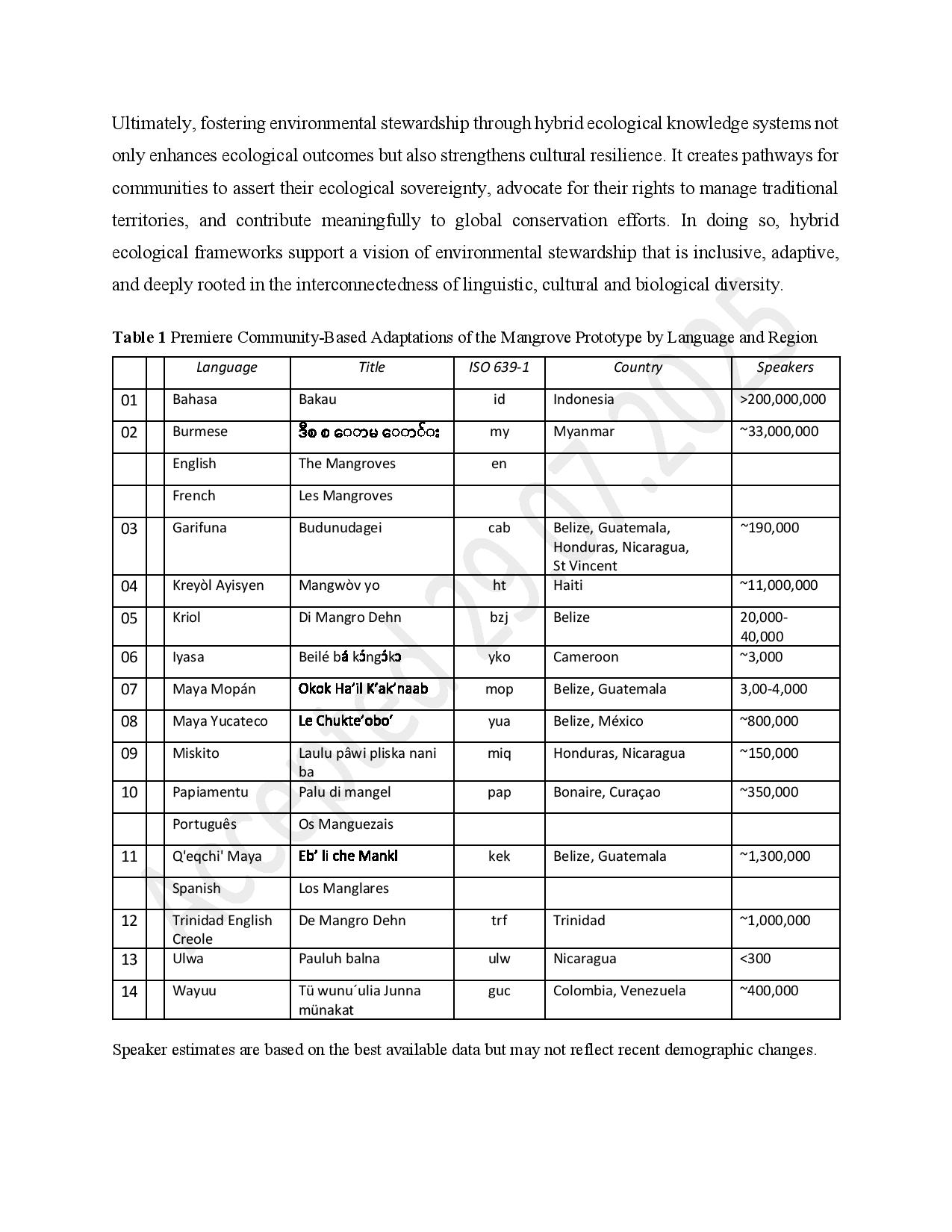
This paper examines the integration of Indigenous and Creole ecological knowledge systems with Western science through the lens of the Hybridization Hypothesis of Ecological Knowledge Systems. This hypothesis posits that synthesizing diverse ecological knowledge systems creates a more holistic framework for environmental management. Central to this integration is the concept of biocultural constants, shared features of biological and cultural systems that remain consistent across time and space within a species range or ecoregion. Through a case study of a bilingual mangrove curriculum, this study demonstrates that communities across linguistic groups independently recognize common ecological knowledge, supporting the existence of biocultural constants. The findings emphasize that hybridized ecological knowledge, delivered in the mother tongue, strengthens ecological stewardship, fosters cross-cultural collaboration, and enhances community resilience. Recognizing and integrating diverse ecological perspectives through hybridization provides a pathway toward more inclusive, adaptive, and sustainable environmental strategies.
EDUCACIÓN AMBIENTAL INTERCULTURAL: DESARROLLO Y PILOTAJE DE LIBROS EN LENGUA MAYA PARA NIÑOS DE PRIMARIA INDÍGENA EN QUINTANA ROO
TESIS
Para obtener el Título de:
Maestría en Educación Intercultural
PRESENTA
Lic. Hilario Poot Cahun
José María Morelos, Quintana Roo, México.
Mayo, 2025.
RESUMEN
Hace veinte años, al caminar por las calles, parques y mercados de las comunidades mayas, se escuchaba a toda la población hablando en su idioma local, desde los niños hasta los abuelos. Sin embargo, en años recientes, en esas mismas comunidades, solo los adultos y personas mayores continuaron usando la lengua maya. Las nuevas generaciones comenzaron a adoptar el español como lengua materna. El censo realizado en México en 2020 mostró una disminución de casi un 12% en el número de hablantes de maya yucateco (El Chilam Balam, 2021). Con miras al censo de 2030, este proyecto se propuso contribuir a reducir dicha disminución o, al menos, mantener estable el número de hablantes mediante su implementación en comunidades mayas de Quintana Roo, con potencial de expansión hacia otras regiones de México y Mesoamérica. Los resultados obtenidos reflejaron avances significativos, los cuales se presentaron en esta tesis con el objetivo de obtener el grado de Maestría en Educación Intercultural.
Non-lethal Methodology for Stable Isotope Analysis of Spiny Lobsters (Panulirus argus)
 Non-lethal Methodology for Stable Isotope Analysis of Spiny Lobsters (Panulirus argus)
ROBERT P. CREED JR.1 and ROBERT C. THIGPEN III1,2,
1 Department of Biology Appalachian State University, Boone North Carolina, 28608 USA
2 Department of Anthropology, Appalachian State University, Boone North Carolina
Proceedings of the Fifty Ninth Annual meeting of the Gulf and Caribbean Fisheries Institute
November 2006 Belize City 2006
ABSTRACT
Stable isotope analysis (SIA) is used to determine animal diets and construct food webs. Tissue sampling methodology for SIA is usually lethal to the study organism. As various species become endangered worldwide, it is important to de-velop non-lethal methods of sampling tissues for SIA. In crustaceans, animals are usually killed and abdominal tissue isused for SIA. We sampled tissues from other body parts (walking legs, antennae) of the Caribbean spiny lobster (Panulirus argus) that can be removed without killing the animal to determine if they would produce SI signatures similar to abdominal tissue. Lobsters were collected from seagrass meadows in the vicinity of Caye Caulker, Belize during July and August of 2006. Tissue samples were taken from 10 adult lobsters, 5 males and 5 females. Leg and abdominal δ13C values were not significantly different; antennal δ13C signatures were significantly different from those of abdominal tissue. Regression analysis demonstrated that isotopic carbon ratios from leg tissue were better predictors of abdominal carbon ratios (r2=0.918). Leg tissues had significantly higher δ15N signatures than abdominal tissue and antennal δ15N values were significantly lower than abdominal values. We conducted a regression analysis to determine if either leg or antennal tissue SI values would be a good predictor of abdominal δ15N values. The r2 for the relationship between abdominal tissue and antennal tissue (r2=0.677) was higher than that for leg and abdominal tissue (r2=0.476). Despite the poorer relationship between leg and abdominal N signatures we feel that walking legs are the preferred tissue to remove since the loss of one walking leg probably has less of an effect on lobsters than the loss of an antenna. Our results suggest that tissue removedfrom other body parts of crustaceans can be used to assess diet and determine trophic level assignment.